Our Services
Deep Strike provides specialist support across geophysical survey design, data QA/QC, interpretation, and reporting — particularly for electrical and electromagnetic methods. Below is an overview of our core capabilities.
Induced Polarisation (IP)
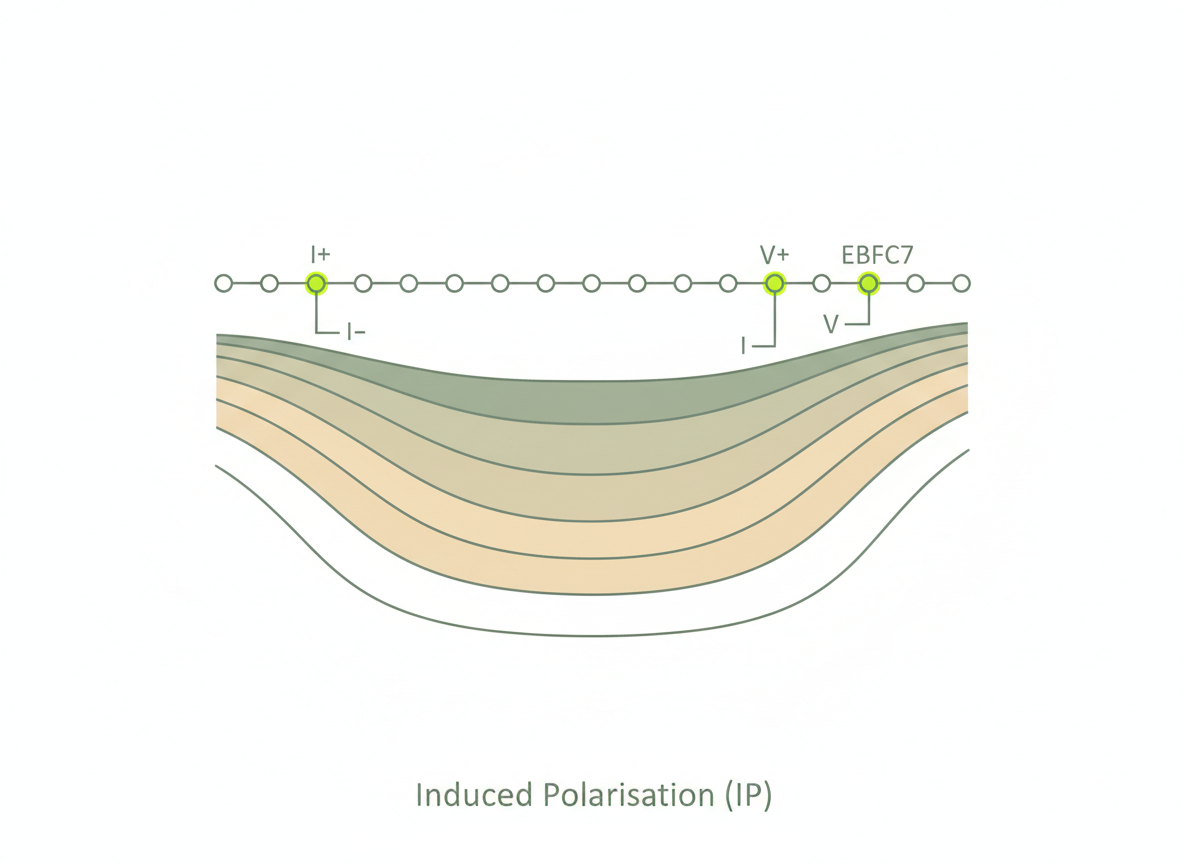
Induced Polarisation measures the subsurface electrical response to a transmitted current, producing resistivity and chargeability outputs. IP is widely used to map lithological contrasts, alteration systems, disseminated conductive phases, and structural controls — especially where resistivity and chargeability patterns together improve discrimination.
Typical scope includes:
Data QA/QC (contact resistance, current levels, noise performance, repeatability)
Review of processing and inversion (2D/3D), with sensitivity and uncertainty checks
Integrated interpretation using resistivity + chargeability domains
Clear deliverables: sections, depth slices, interpreted domains, and prioritised features
Best used when you need:
Subsurface contrast mapping, chargeability/resistivity discrimination, and structurally controlled target definition — supported by transparent inversion and defensible uncertainty statements.
CSAMT (Controlled Source Audio-Frequency Magnetotellurics)
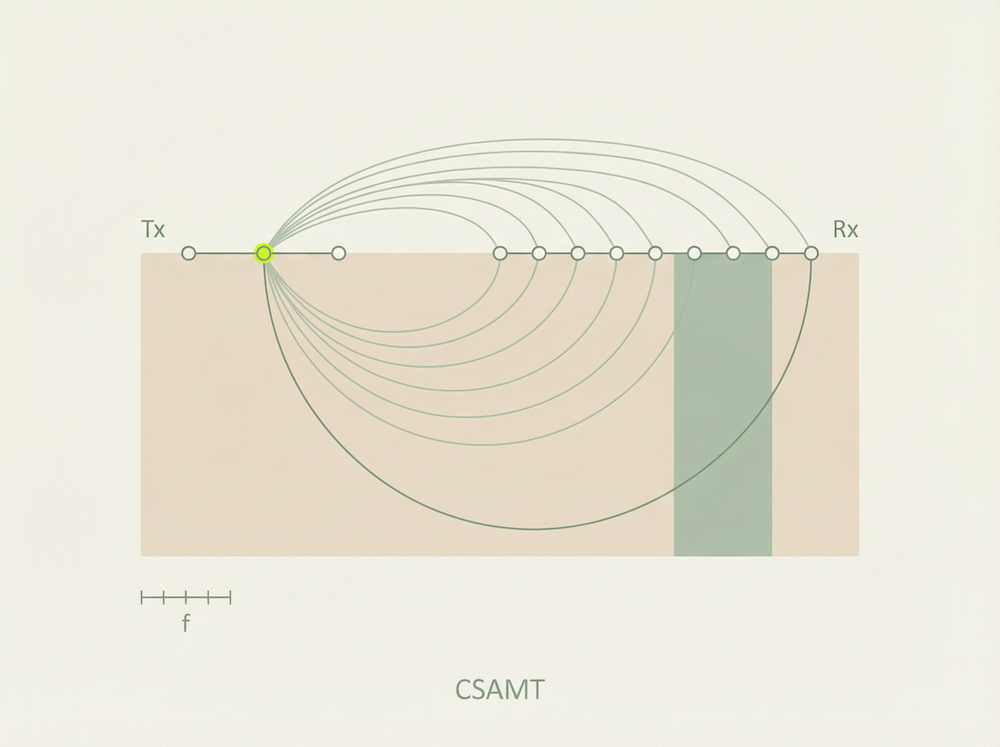
CSAMT uses a controlled transmitter and measures the subsurface electromagnetic response across audio frequencies to derive resistivity structure with depth. It is particularly effective for mapping major resistivity boundaries, conductive horizons, and structural corridors, and for building a deeper resistivity framework than many near-surface methods.
Typical scope includes:
Survey design review (source–receiver geometry, frequency plan, station spacing)
QA/QC of field data (coherency, cultural noise, coupling, repeat station analysis)
Processing/inversion review and resistivity model validation
Interpretation of structural and stratigraphic resistivity architecture
Best used when you need:
A reliable resistivity framework, deeper structural mapping, and clear identification of conductive/resistive domains — especially when noise handling and model validation are critical.
Time-Domain Electromagnetic (TDEM) Surveys
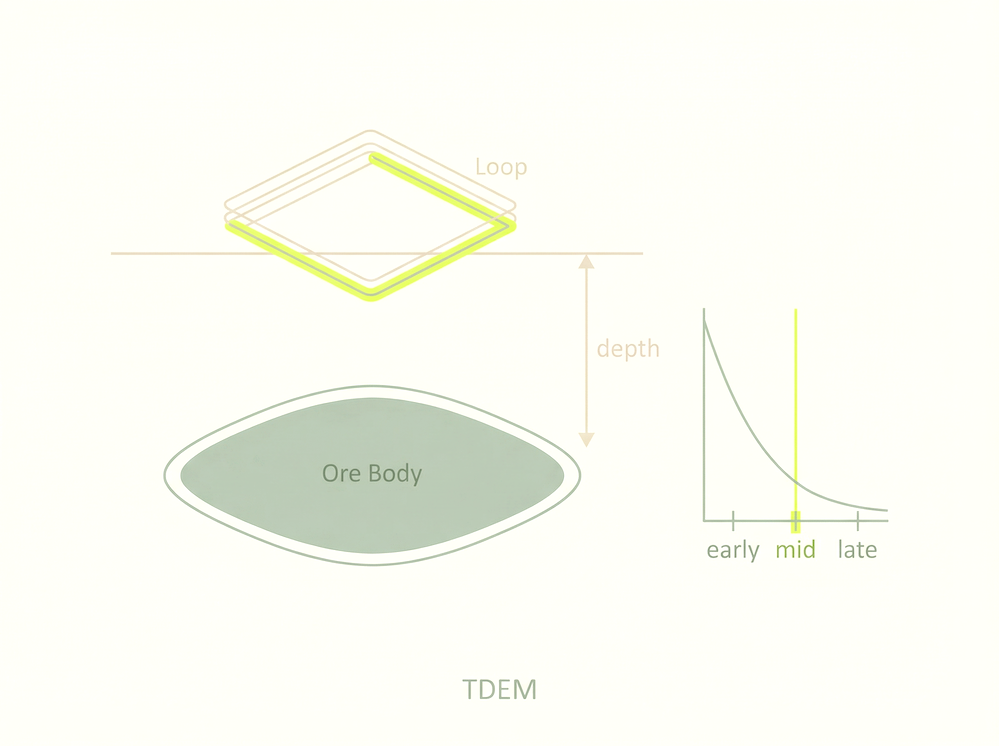
TDEM measures the decay of induced currents after transmitter shut-off to map conductivity variations with depth. It is a powerful method for identifying discrete conductors, conductive horizons, and conductivity contrasts - often providing strong guidance on geometry, depth trends, and continuity.
Typical scope includes:
System and parameter selection support (waveform, moment, base frequency, stacking)
QA/QC (noise, drift, repeatability, coupling effects, gate selection)
Inversion review (1D/2D/3D where appropriate) and conductivity model validation
Interpretation focused on conductor geometry, depth extent, and uncertainty
Best used when you need:
Conductivity mapping and conductor characterisation with realistic depth constraints and practical guidance on what the data can, and cannot, support.
Typical deliverables
QA/QC findings and data integrity summary
Processing/inversion review with sensitivity notes
Interpreted sections, maps, depth slices
A clear list of interpretations, uncertainties, and recommended next steps
Contact us
Not sure which method fits your problem?
We’ll help you choose the simplest approach that answers your questions and avoids unnecessary spend.